Area 2 | Cold War Berlin
2.1
Everyday Life in Occupied Berlin
In two weeks and two days between April and May 1945, Berlin was conquered by the Soviet Army in a grueling final battle of a horrific war that had been unleashed by Nazi Germany. The Soviets occupied a city that lay largely in ruins. For Berliners, life under occupation was full of want and insecurity. Living conditions were miserable, and the black market thrived among the rubble. Berliners now faced their former enemies as occupiers. The former Nazi capital, along with the country as a whole, came under temporary Allied rule. Each of the four victorious powers – the Soviet Union, the United States, the United Kingdom, and France – took on primary responsibility for one zone of Germany – and for one sector of the city.
But as the wartime allies turned adversaries in a new kind of confrontation, by 1948/49, Germany’s zonal partition hardened into the division of the country into two states. Berlin once again became an embattled city, and Berliners had to learn how to live on a frontline of the Cold War.
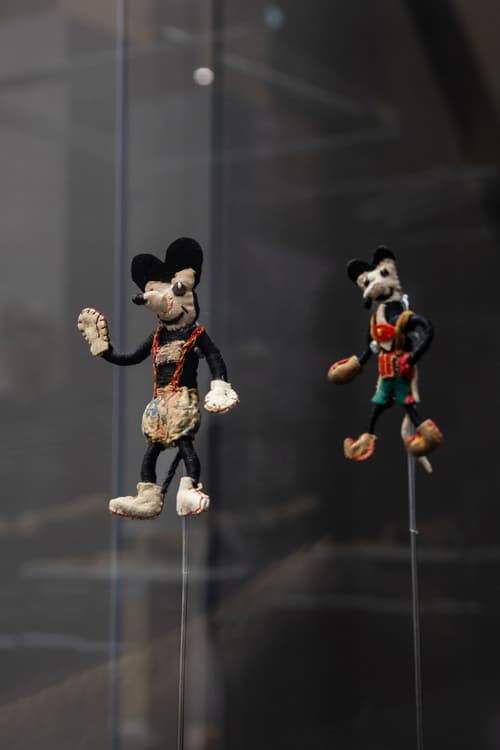
Two handmade
Mickey Mouse dolls, 1946
US soldiers brought American popular culture to post-war Berlin, including the popular cartoon character Mickey Mouse. A Berlin mother surprised her 12-year-old daughter and 15-year-old son with these handmade dolls modeled after the American originals.
AlliiertenMuseum, Berlin
A city in
crisis mode
In the late 1940s Berliners found themselves at a frontline in the confrontation between the United States and the Soviet Union. The heightening Cold War reverberated into the city’s life. Tensions erupted in the “Berlin Blockade” crisis of 1948–1949, the failed Soviet attempt to avert the formation of a West German state by blocking access routes between West Germany and Berlin. The successful US-French-UK airlift which brought supplies to the western part of Berlin forged a strong relationship between the western allies and Berliners.
Though the blockade ended in May 1949, crises persisted. The establishment of a new Communist government in the Soviet sector split the city politically. As the American-Soviet confrontation heightened in the 1950s, the city became a Cold War hotspot. For many Berliners, the threat of civil unrest and military conflict felt real and acute.

Pitty city scooter, 1955
140 kg, 70 km/h
In 1946, the Italian company Piaggio launched the Vespa scooter as a cheaper alternative to the automobile, which was still out of reach for many, and to motorcycles, viewed as working-class machines. The East German Pitty, the first Eastern bloc scooter, was launched in 1955 at the Ludwigsfelde plant near Berlin. It was a direct response by the GDR government to people’s demands for greater availability of consumer goods in the aftermath of the 1953 uprising. Only the first series had hand-painted lettering. This example was found abandoned in a barn.
Verein Freunde der Industriegeschichte Ludwigsfelde
Photo: Roland Berger, Pitty’s designer, on the prototype
Open Border – Dangerous Border
Even as the city’s political division deepened, the sector border between East and West Berlin remained open, and it was common for Berliners to work, shop, or go to the theater in the other half of the city. An estimated 500,000 people crossed it every day. During crises, Berliners’ free movement proved challenging for the governments on both sides and led to temporary closures.
For Berliners, the possibility of moving back and forth between the two halves of the city, and so between the two systems, meant both opportunities and growing risks. Not only could Berliners explore the reality of the other system, they could also take advantage of the opportunities offered by the division: cheap bread on one side, a free press on the other. Hundreds of thousands of East Germans used the open border as an easy exit route to a new life in the West. But Soviet sector police guarded the border with increasing rigor, and some 39 people were killed before the border was closed in 1961. By then, about a sixth of the GDR population had left.

Bunk bed, blanket, shaving equipment, toothbrushes, shirt, and nightgown from Marienfelde refugee center, 1970s
To avoid attracting attention when crossing the border, some refugees brought almost nothing with them. Many arrived in the West in the middle of the night and without even the basic necessities. The refugee center provided them with a few essentials.
Stiftung Berliner Mauer, Berlin
2.2
Cold War rivalry
As Cold War tensions mounted in the 1950s, the Western powers and the Soviet Union – and both Berlin city governments – used their respective parts of the city to showcase the allure and superiority of their political system. The city became a stage for this competition. Every aspect of civic life, from the food supply and cultural activities to housing and urban development, played a role. Berliners were in the unique position to be able to compare their experience in each system. The Cold War rivals also tried to mobilize Berliners to support their cause and turned the city into a center of propaganda, espionage, and covert operations.
Berliners took an active part in this rivalry. With their lives, work, and relationships often spanning across all of Berlin, they took sides, moved between the systems, and, at times with considerable risk, tried to exploit the competition to their own advantage.
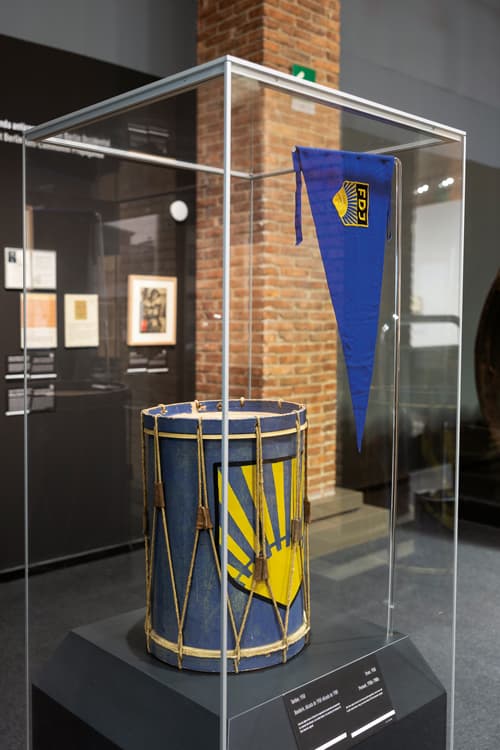
Drum, 1950
Pennant, 1950s-1980s
These objects show the East German communist youth organization’s coat of arms with its gold colored border, rising sun and the initials FDJ (Freie Deutsche Jugend).
Drum, 1950
The Wende Museum,
Culver City
Pennant, 1950s¬1980s
Stiftung Haus der Geschichte der Bundesrepublik Deutschland, Bonn
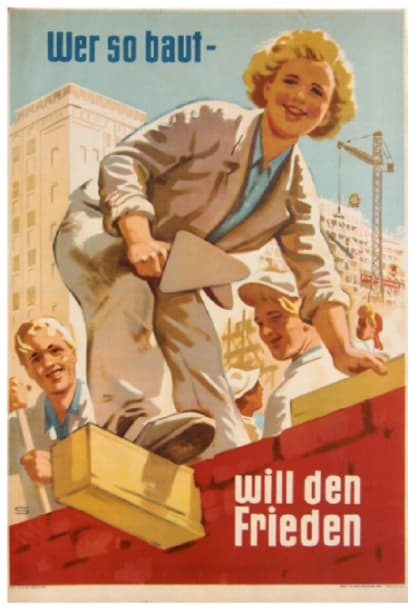
‘Who builds like this, wants peace’ poster by Günter Schmitz, 1952
The poster on Stalinallee promotes the communist worldview in two ways. It emphasizes the active role of women, now working in traditionally male jobs, and claims peace as the goal of socialist work.
Stiftung Haus der Geschichte der Bundesrepublik Deutschland, Bonn
Jamming between the systems

Reconstruction of the IG Jazz club
Interessengemeinschaft Jazz (IG Jazz) was founded on December 18, 1955. The first meeting took place at a clubhouse of the East German youth organization named after an alleged East Berlin border victim, Helmut Just. There were chairs for the audience and a table at the front of the room with a portable record player on which jazz records were played.
IG Jazz meeting in the Helmut Just Clubhouse, 1958
Collection of Helmut Eikermann, Berlin
East German kitchen table and chairs, as used in IG Jazz events, 1950s
Musealia, Donostia San Sebastián
An East German EAG Phonokoffer Sonni suitcase record player, manufactured by RFT, 1960
Musealia, Donostia San Sebastián