Area 4 | Global Revolutions
4.1
A Changing World
While Berliners learned to deal with the Wall, the divided world of the Cold War was undergoing profound changes. Across Africa and Asia, the breakup of colonial empires gained speed with the end of World War II. Latin America saw new struggles to address political and economic inequities. In the Non-Aligned Movement, some of the newly formed postcolonial states refused to be drawn in by the Cold War blocs, advocated nuclear disarmament, and demanded a voice in international affairs. Superpower interventions and proxy wars turned the Global South into Cold War battlegrounds, often at a staggering human cost.
In societies across the globe, social and economic changes also challenged the logic of Cold War divisions. Within both blocs, young people tested new cultural practices that questioned, or ignored, the prevailing Cold War consensus. Technological innovations intensified exchanges across state and bloc borders. Globalization benefited the spread of market systems and Western soft power. Progress in Western productivity contributed to a general crisis in the communist world. The growing rise in universal human rights in international politics empowered dissent and opposition to ideological authority anywhere, but particularly in the Eastern Bloc.

Avtomat Kalashnikova
(AK-47), 1970 – Replica
The AK-47 was developed in the Soviet Union. Within 25 years after its prototypes were finished in 1947, it had become the most abundant infantry rifle the world had known. Because it was reliable and easy to use, it became the most common weapon used worldwide not just in conventional but also guerilla and urban warfare, repressive interventions, and terrorist attacks during the Cold War.
ANIVEL
Counterculture
Since the 1950s, young people in particular had been looking for new forms of cultural expression. Popular music was a principal outlet, but it was also reflected in literature and other arts. The young – in the West, the East and the Global South – challenged the traditional elites. By the late 1960s, the global countercultural movement was influencing mainstream society. It sought personal freedoms, opposing traditional restrictions enforced by a Cold War culture of public discipline. A part of this generation refused to support ¬– and in some cases be conscripted for – the confrontations of the Cold War.
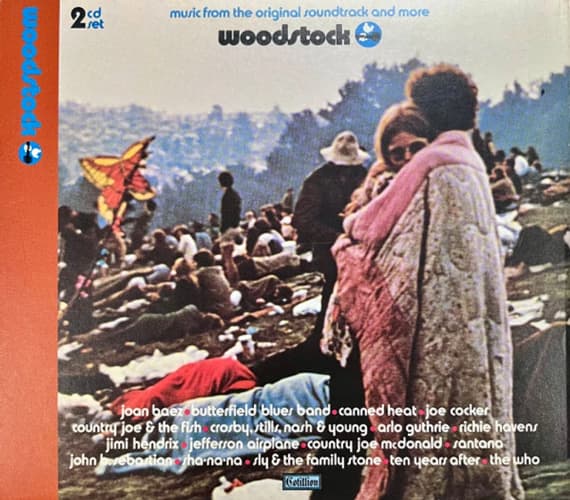
Woodstock: Music from the Original Soundtrack and More
Cotillion Records, 1970
Technological Revolution
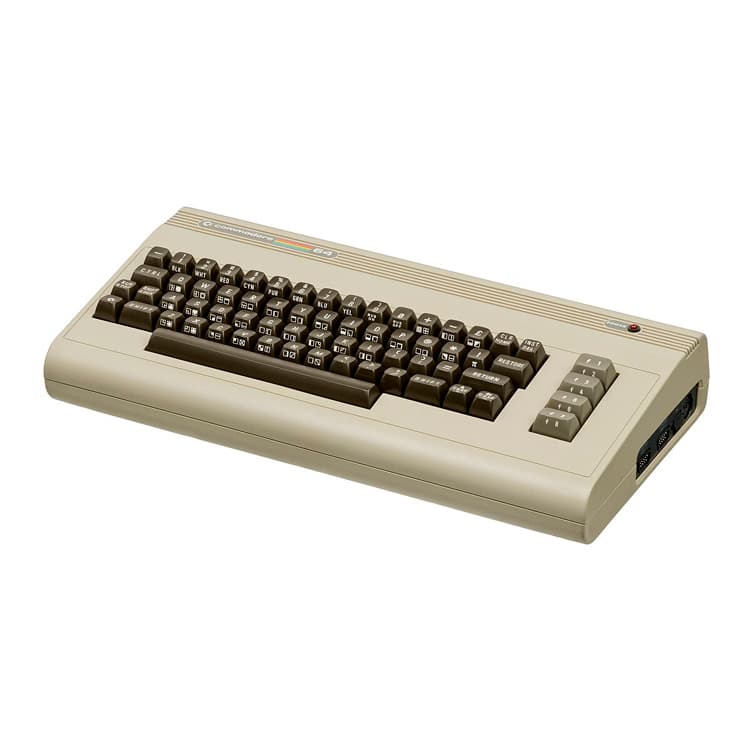
Commodore 64
The Commodore 64 was a best-selling gaming computer with better visuals and audio than previous machines. In the early 1980s, it made both playing games and learning computing more accessible and affordable.
Musealia, Donostia-San Sebastián
Human Rights Revolution

Polish samizdat publications
In the 1980s, underground (samizdat) publications were often delivered in packages at night. The self-produced and illegal books and journals had a wide audience and were a grassroots practice to avoid communist censorship.
Research Library of the Herder Institute for Historical Research on East Central Europe, Marburg
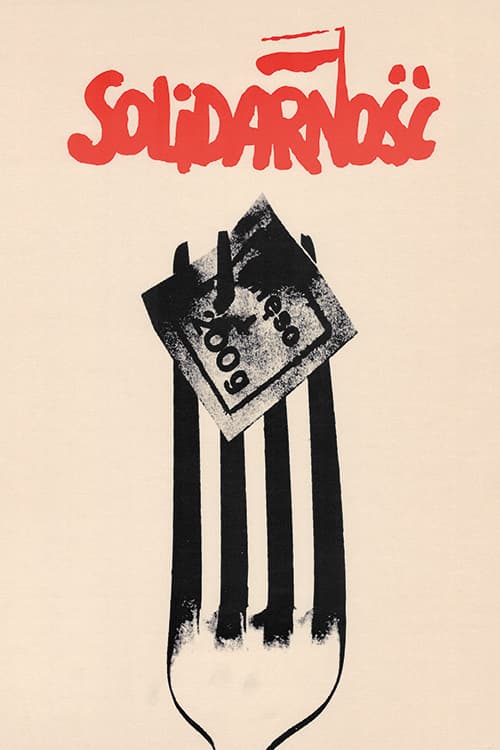
Shortage of Food poster,
1981
This poster by Solidarność [Solidarity] is a commentary on the food crisis in Poland, showing a voucher entitling people to buy 200 grams of meat. Founded in 1980, Solidarność was the first free trade union in the Communist world and would play a leading role in Poland’s freedom revolution in 1989.
Collection of European Solidarity Centre, Gdańsk
4.2
The Return of Fear
By the early 1980s, acute fears of nuclear war – not seen since the early 1960s – resurfaced in the Global North. Mistrust and confrontation between the two superpowers escalated dramatically as nuclear arsenals reached new heights. Soviet and communist advances in the Global South – climaxing in the Soviet invasion of Afghanistan in December 1979 – led the United States to launch a global anti-communist offensive. In Europe, the rise in Cold War tensions led to new deployments of nuclear missiles by the two opposing military alliances, the Warsaw Pact and NATO.
Many people in East and West were afraid the world was heading towards a nuclear inferno. Concerns over radioactive contamination caused by the Chernobyl reactor disaster in Soviet Ukraine in 1986 deepened anxieties over the danger of a nuclear catastrophe. Dystopic films and books imagining nuclear war and its aftermath amplified such anxieties. Millions of people in Europe, the Soviet bloc, and North America, increasingly linked in transnational movements, took to the streets to protest against the arms race and for peace.
The Samantha Smith Story
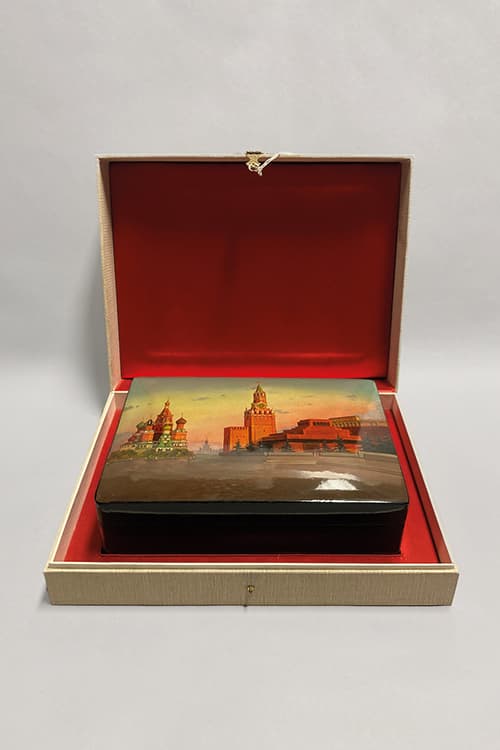
Fedoskino lacquer box and presentation case, 1982
Soviet leader Andropov presented this box to Samantha as a gift during her trip to the Soviet Union in 1983. It was made in Fedoskino, one of the best-known towns in Russia for lacquer work.
Main State Museum, Augusta
Anti-Nuclear Protests

Thalia Campbell, Girls Say No to the Bombs banner, 1980s
In the United Kingdom, the members of the Greenham Common Women’s Peace Camp held a series of camps to oppose the deployment of nuclear-tipped cruise missiles (long-range guided missiles). The protestors developed special artwork to communicate their political messages.
The Peace Museum, Bradford
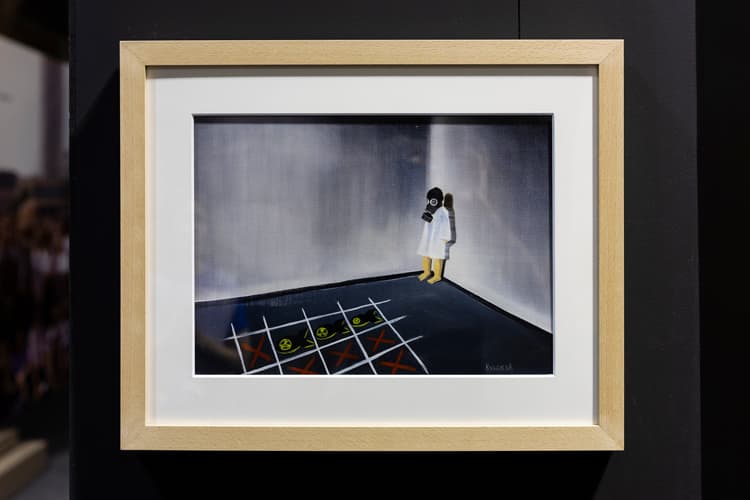
Karipbek Kuyukov, Girl with gas mask, 2020
The little girl in the painting by the Kazakh artist appears to be cornered in a radioactively contaminated room with no means of escape. The artist , who grew up near the Soviet nuclear test site in Semipalatinsk, had to endure the consequences of atomic testing himself: he was born without arms because of his parents’ exposure to radiation.
Musealia, Donostia-San Sebastián
Photo: Courtesy Karipbek Kuyukov
4.3
The Revolutions of 1989
The fall of the Berlin Wall in 1989 was part of a series of revolutions transforming the Soviet Union and Eastern Europe. Since the 1970s and increasingly during the 1980s, widespread popular dissatisfaction with political and socio-economic conditions in Eastern Europe had challenged Communist rulers. In the Soviet Union, a new leader, Mikhail Gorbachev, inaugurated a transformation process after coming to power in 1985.
By 1989, Gorbachev had also abandoned the principle that the Soviet Union would back Communist rule in the Eastern bloc through military intervention. In Poland, the Solidarność [Solidarity] movement negotiated a power-sharing arrangement with the Communist elite, leading to the first almost-free elections in the Eastern Bloc. In Hungary, reform-minded Communist leaders accelerated the country’s economic opening to the West. In Czechoslovakia, an opposition movement led by dissident intellectuals toppled Communist authorities in the Velvet Revolution. A peaceful ending was not a given: in Romania, the revolution ended in a bloody climax, in China, Communist authorities brutally squashed the democracy-seeking opposition in June 1989.
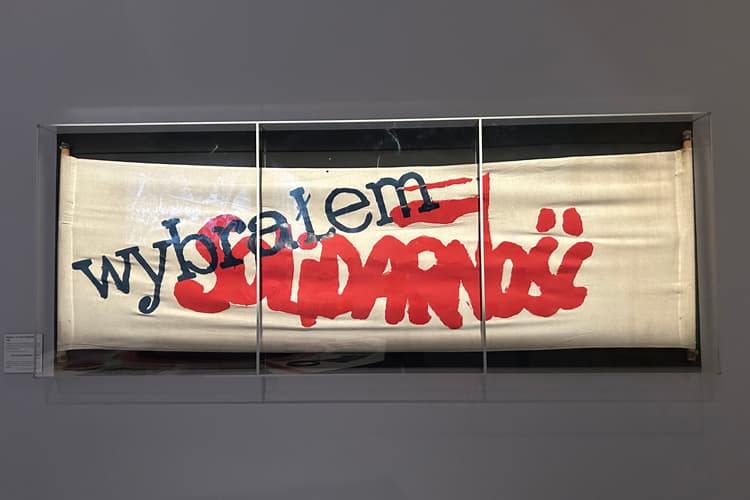
‘I have chosen Solidarność’ banner, 1989
Solidarność pursued a creative, large-scale election campaign, whereas the Communist Party was already in decline. The banner shows support for democratic change.
Collection of European Solidarity Centre, Gdańsk

Cropped Romanian tricolor flag, 1989
The cropped Romanian tricolor was the key symbol of the Revolution of 1989. The revolutionaries took the flag of the Socialist Republic of Romania and cut out the communist symbols in the center, thus transforming a symbol of the Communist regime into one of hope.
Musealia, Donostia-San Sebastián
Germany
By the late 1980s, a deepening political and economic crisis gripped East Germany whose hardline leadership opposed Gorbachev’s reforms. It resulted in growing disaffection and opposition. Despair and discontent led some citizens to try to flee to the West. Others began to push for political and economic change. By the autumn of 1989, protests were shaking the Communist Party’s authority.
With mass migration and mass protests increasing dramatically, the government was forced to introduce a reform program, including abandoning travel restrictions that led to the opening of the Berlin Wall on November 9, 1989. The fall of the Wall opened the way to democratization and to overcoming the division of Germany. Yet, unification was a complex and difficult process. It involved rapprochement between former Cold War adversaries and the coming together of two quite different societies.

A refugee’s doll
A girl from East Berlin carried this doll during her escape via Prague and Vienna to Bavaria in Southern Germany.
Stiftung Haus der Geschichte der Bundesrepublik Deutschland, Bonn
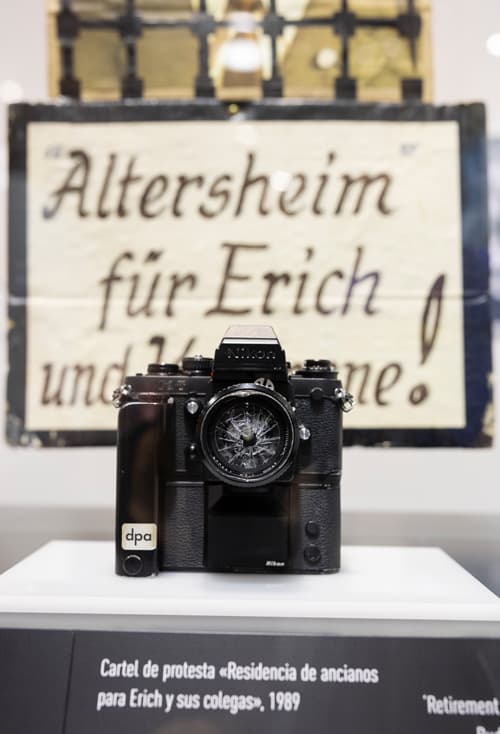
Nikon F3T camera, 1986
The camera belonged to a West German press photographer. It was deliberately damaged by the Stasi (the GDR’s secret police) during a demonstration in East Berlin in 1989.
Stiftung Haus der Geschichte der Bundesrepublik Deutschland, Bonn
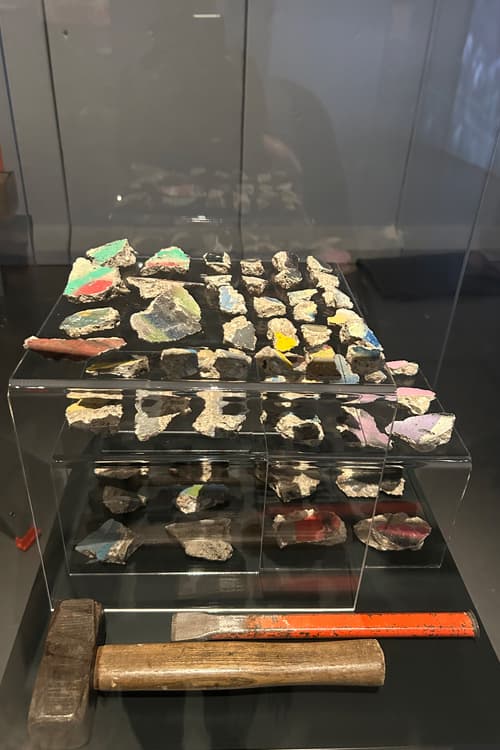
A ‘wall pecker’ with hammer and chisel
As soon as the Wall was open, people started destroying this hated construction and taking away pieces of it as a sign of victory and liberation. ‘Wall pecker’ was a new term invented for those who participated. Bernd Thiele had experienced the division of Germany and the sealing of the border between West and East Germany. In July 1961 the 16-year-old Bernd and his family had fled from Leipzig to Bavaria. In March 1990, he returned to Berlin and used this very hammer and chisel to hack out chunks of the Wall to acquire fragments of historic testimony.
Family Thiele