Area 3 | The Wall
3.1
Division
West Berlin, isolated from West Germany and an island in the middle of East Germany, was a constant thorn in the side of Communist East Germany. Controlled by the Western powers and used as a base for anti-communist activities, it was a persistent challenge to East German sovereignty. By the late 1950s ever-increasing numbers of East Germans were using West Berlin as a gateway to leave for the West.
In November 1958, Soviet leader Nikita S. Khrushchev demanded the removal the Western Allies from Berlin and the transformation of West Berlin into a “free city.” However, US president John F. Kennedy insisted on maintaining Western forces in Berlin. Finally, the leaders of the Soviet bloc decided to seal off West Berlin.
On August 13, 1961, the East German government closed the borders of West Berlin to GDR citizens. The Wall that followed tore apart families, friends, and neighborhoods. It ended the international crisis over Berlin but severed the social fabric of the city and deprived Germans in the east of their freedom to live where they chose.

Unreturned book
The Amerika Haus was established to bring US culture to Berlin. Its library included this German language edition of American Politics. An unknown East Berliner borrowed the book but, after the border was closed, was unable to return it.
AlliiertenMuseum, Berlin
The Wall and the people on Bernauer Strasse, West Berlin
Bernauer Strasse became famous in August 1961. Here, the border ran close to buildings in the East Berlin part of the city. What was hidden at other places along the border – the suffering of people separated from each other and the desperate escapes – could easily be seen here. Journalists from all over the world came to this street to capture stories and pictures. Bernauer Strasse became a symbolic venue for the events unfolding in August 1961. It shaped the international understanding of a divided Berlin.
Bernauer Strasse was also the street where on August 15 the barbed-wire barrier was first transformed into a wall. It was from here that news reached the world that the East German government was turning the temporary barriers into a permanent border structure.

Jochen the bear, 1909
When the Hildebrandt family had to move out of the house on the border, 4 Bernauer Strasse, Jörg Hildebrandt took this teddy bear Jochen with him. The bear had been given to him by his father as a first-birthday present. For many years, this teddy always accompanied Jörg. In 1989, he gave it to his daughter when she decided to flee to the West.
Collection of Jörg Hildebrandt, Berlin
Propaganda and the Wall
The Wall became a political symbol in a divided Germany, employed by each side to malign the other. References to the Nazi past played an important role. While the East accused the West of restoring Nazi criminals to public offices and continuing their policies, the West reproached the East for establishing a Nazi-like dictatorship.
In the official parlance of the East, the Wall protected East Germany from ‘fascist elements’ in the West which sought, along with US ‘imperialists’, to forcibly take over the GDR. In Eastern propaganda, the wall was presented as a measure to preserve peace.
In the West, the Wall became an iconic image for oppression and the violation of human rights under communism. In the early years, some compared the walled-in East to the Nazi concentration camps – sites of extraordinary violence and mass murder.
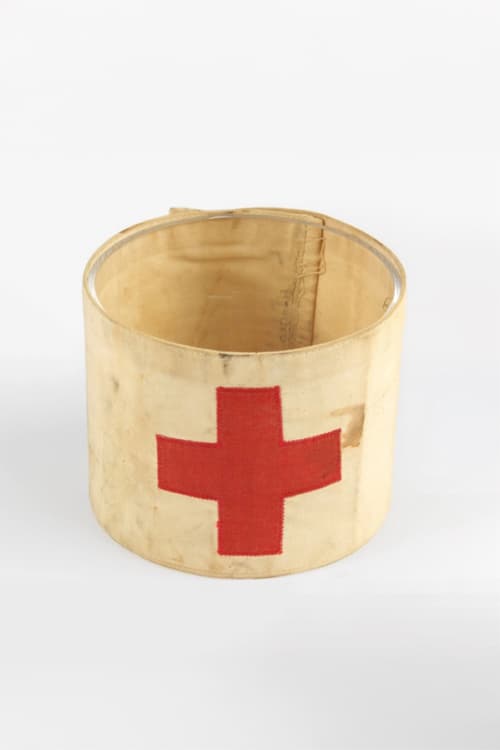
Armband of a US military medic
Daniel E. Southards was a medic in the US army. He wore this armband during his deployment at Checkpoint Charlie. He knew how quickly the situation could have escalated. Hundreds of onlookers, intrigued at unfolding events, gathered on Kochstrasse.
AlliiertenMuseum, Berlin
Standoff at Checkpoint Charlie

A Moscow-Washington ‘hotline’ teleprinter, 1979
As a result of the Cuban Missile Crisis, the so-called ‘hotline’ for direct communication between Washington and Moscow was established on August 30, 1963. Popularly known as the ‘red telephone,’ the hotline in fact worked through teleprinters. This teleprinter was manufactured in East Germany, with keyboards in both Cyrillic and Latin alphabets.
Sächsisches Industriemuseum Chemnitz.
Image: Getty Images/Bettman
3.2
The Border Regime
Once the Wall around West Berlin was built, the East German government began to develop an intricate border regime, integrating an increasingly effective, almost insurmountable system of fortifications and obstacles. The function of this border system was to prevent East Germans from leaving the country. Armed soldiers reinforced the physical barriers.
The border system ran 43 kilometers through the city and a further 113 kilometers around the outskirts of West Berlin. Over the years, the GDR border regime extended its influence deeply into East German society, involving a growing complex of people and agencies, all working together to make the border as impermeable as possible. The border regime contributed in crucial ways to making the GDR the police state it was.
Despite the risks, people continued to flee the GDR by scaling the Wall. More than 5,000 made it to West Berlin, but tens of thousands were arrested and 101 people died trying to overcome it by this method.
The border area
The urban quarters adjacent to the border strip in East Berlin formed a formal border area. Established in 1963, a regime of special restrictions and tight surveillance was created for residents and employees to live or work there. Even family members needed a special permit to visit residents, which had to be applied for weeks in advance. In 1963, 16,000 residents and 16,000 employees of some 120 companies were affected.
The border troops, the East German police and the Stasi (the GDR secret police) were jointly responsible for monitoring this area. They received support from the population through informants and voluntary assistants. The restrictions created never-ending conflicts between local residents and the police. For this reason, and in order to reduce control efforts, the border area became smaller over the decades.
Living with the Wall

Steel ‘surface barrier’ with spike gratings, 1980s
The border troops installed obstacles like these throughout the border strip in the mid 1960s. The upward-pointing steel spikes were designed to severely injure refugees when they jumped down onto them, thus putting an end to their attempt to escape. They were removed in the mid-1980s.
Graphic adapted from border strip plan, 1983. Bundesarchiv, DVH 32/127608 Image: Stiftung Berliner Mauer, Berlin. Photo: Hans-Peter Stiebing
Stiftung Berliner Mauer, Berlin
The Wall, the soldiers and the victims
What made the Wall potentially deadly to escapees were the armed border soldiers deployed to arrest or, if necessary, shoot them. These soldiers were young men, mostly conscripts. Many disagreed with the border regime. The government made enormous efforts to condition them to follow orders. Still, some resolved never to fire a shot or to miss their targets but others were ready to pull the trigger. Most postponed such a decision, hoping that it was one they would never have to make.
By 1989, approximately 40,000 East German citizens had managed to breach the border fortifications, 5,000 in Berlin alone. It is estimated that 75,000 failed escapees were arrested and sentenced to prison. Between 1961 and 1989, 140 people were killed by border soldiers or suffered fatal accidents at the Wall. Together with those who died on the GDR border, those who died at the Berlin borders before the Wall was built, and those who perished while escaping across the Baltic, an estimated 650 people lost their lives as a result of the GDR border regime between 1949 and 1989.
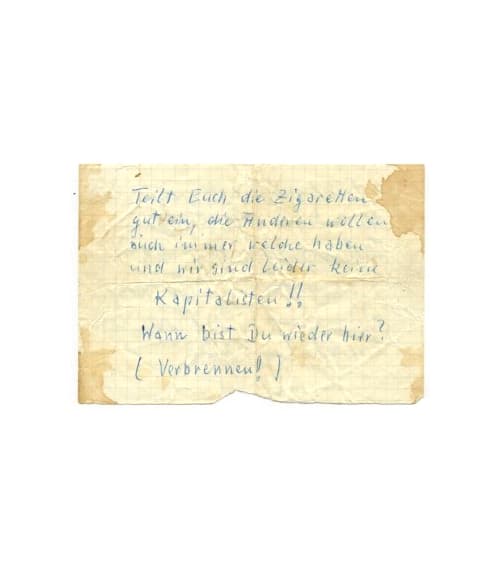
Messages over the wall, 1960s
Some border soldiers, dissatisfied with their service and their mission, maintained contact with West Berliners across the Wall. At Bernauer Strasse, they threw handwritten notes over the Wall and Western residents threw their replies back. Though it was strictly forbidden, it took years to suppress this practice. The border soldiers had to be exchanged several times, as the communication not only concerned material wishes, but the soldiers also expressed their displeasure with the service.
Translations:
East German border guard: «I have a request! Would you be so good and throw me a pair of seamless stockings over the ‘wall’? It’s hard to get them here. Size 9 1/2, not too bright! Many thanks in advance. Your friend!»
A West Berliner: «Please, write down an address where we can send the stockings, or we will throw them over from here once you have returned but the first would probably be better! Your friends»
East German border guard: «We have 10 Deutsche Marks (West). Can you get us some cigarettes with it!”
A West Berliner: “Look after the cigarettes well, the others will always want to have some too, and we are unfortunately not capitalists! When will you be back? (Burn!)»
Facsimiles, Stiftung Berliner Mauer, Berlin. Gift of Christa Arndt
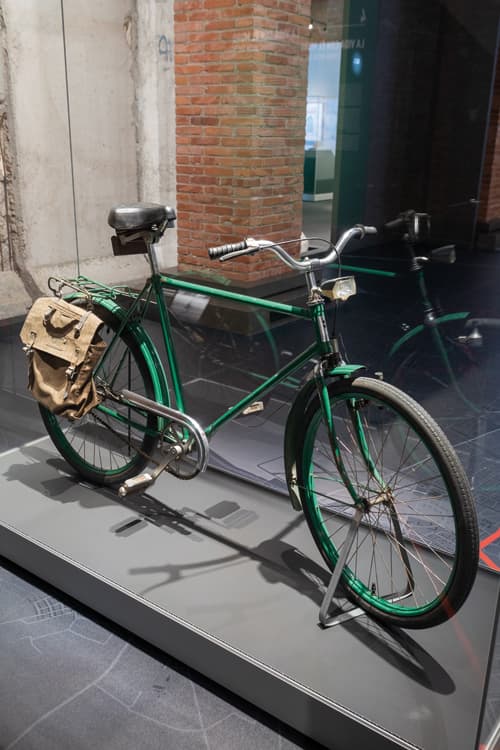
Border troop bicycle, 1970s
As the Wall was over 155 kilometers long, the border was patrolled by troops using bikes or cars or walking. The troops worked in pairs on a given section of the Wall. Watchtowers remained the most important means of monitoring potential escapes.
Image from October 15, 1979. Stiftung Berliner Mauer, Berlin. Photo: Edmund Kasperski Stiftung Berliner Mauer, Berlin
Underground border
When dividing the city, authorities failed to appreciate that the separation of friends and families would increase their citizens’ desire to leave for the West. In August 1961, East Berliners trying to escape discovered routes via the city’s underground infrastructure: the sewage system and the tunnels used by the city’s subway and commuter trains. Some assumed these routes would be less dangerous than through the border fortifications, and West Berliners smuggled maps of underground Berlin to help.
A little later, people started digging tunnels to get out of East Berlin. Because such projects were difficult to conceal, most tunnels were dug from West to East Berlin, mainly by young men to bring relatives and friends through. On average it took six months to build a tunnel. The East German government continually tried to plug these breaches of the border. Some tunnel projects failed for technical reasons. Others were betrayed by Stasi agents who infiltrated the West Berlin tunnel diggers’ network, which led to numerous arrests.

Mauser pistol of Christian Zobel, manufactured 1920
Some of the tunnellers chose to be armed when they dug through to East Berlin. This gun belonged to Christian Zobel, one of those who built the ‘Tunnel 57’ in the summer of 1964. After 57 East Germans had made their escape, the tunnel was discovered and the tunnel diggers were surprised by border soldiers as they waited for more escapees in an East Berlin backyard. After Christian Zobel opened fire, the border sergeant Egon Schultz was killed in the ensuing firefight by a bullet from his own side.
Stiftung Berliner Mauer, Berlin
Border crossings
The Wall and the suffering it caused altered West German attitudes towards the East German government. Up to 1961 the West followed a policy of non-communication towards the Communist authorities. Such a policy proved increasingly unrealistic, especially since the superpowers improved their relationship after the Cuban Missile Crisis. This created the basis to start a dialogue. Western officials hoped that a rapprochement would alleviate the plight of East Germans and stabilize the situation in Berlin. The East German government, in turn, hoped for international recognition.
A first outcome of these efforts was an agreement in 1963 that allowed West Berliners to visit relatives in the East. Then in the early 1970s the two German states concluded treaties that established official relations between them. One result was the opening of transit routes between West Berlin and West Germany; another, that West Germans and West Berliners could visit East Berlin and East Germany more easily. But, with the exception of retirees, the East German government still denied most East Germans the right to travel to the West. As the new travel opportunities created new chances of escape, the East German authorities expanded surveillance along the transit routes to prevent unwanted contacts between East and West Germans and to impede potential escapees.

Highway sign, circa 1972
A metallic sign from a West Berlin highway points motorists to one of the transit highways to West Germany. The term Grenzübergangsstelle [border crossing] was subsequently mounted on the sign, presumably as a consequence of the transit agreement and the recognition of East Germany and, with that, the border between the two states.
Stiftung Berliner Mauer, Berlin

Winter coat, 1960s
Gudrun F. wore this coat in the winter of 1964 as she waited on the transit highway for a truck to take her out of East Germany. She had deliberately chosen a dark green coat in order to remain inconspicuous. The driver hid her in a cabin made of steel bars under his cab. She had to remain there for more than two hours until she arrived in West Berlin, frozen but happy.
Stiftung Berliner Mauer, Berlin